
The Lillian and David E. Feldman Research
Center for Rehabilitation Sciences

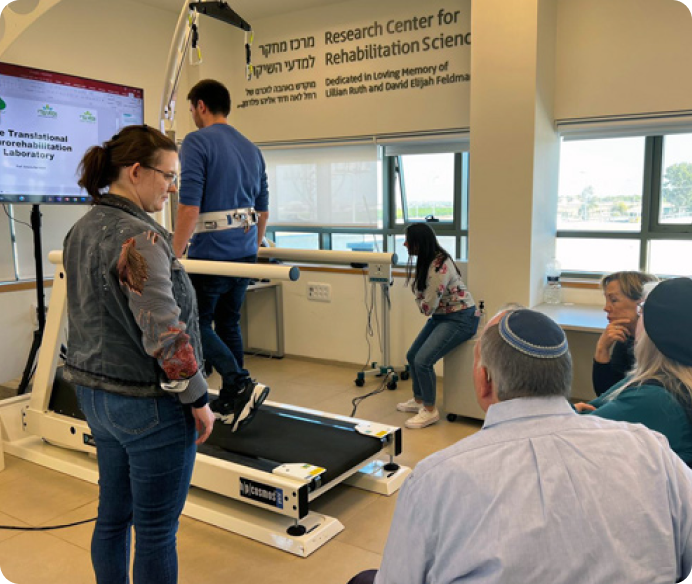
The Lillian and David E. Feldman Research Center for Rehabilitation Sciences at the Kaylie Rehabilitation Medical Center at ADI Negev-Nahalat Eran works with academics to advance research by initiating, planning and funding clinical research.
The Feldman Research Center aspires to provide a broad organizational infrastructure that will facilitate research and the publication of research findings for interested clinical researchers associated with the Kaylie Rehabilitation Medical Center (doctors, nurses, health-professions and medically-related professionals) as well as researcher partners from other sectors. As part of its quest to spawn significant technological achievements for the benefit of people with disabilities and rehabilitation patients worldwide, the original vision of the ADI Negev-Nahalat Eran Rehabilitation Village attaches great importance to such research activity.
Natural History of Stroke
Within the scope of this project, 200 sets of longitudinal physiological and cognitive data sets have been taken from 180 recruited stroke rehabilitation patients.
The original research project has led to additional studies including studies on High Density Controllability, Post-stroke Accuracy in Walking and The Role of the Reticulospinal Tract in Stroke Recovery. These studies are in conjunction with Ben Gurion University.
Additional Rehabilitation
Research Projects
In addition to the aforementioned studies, numerous other
research projects are underway.
Title
Researchers
Dr. Yafi Levanon
Ben-Gurion University of the Negev
Dr. Reut Binyamin-Netser
ADI Negev–Nahalat Eran
Participants
Status
Goals
Researchers
Dr. Yafi Levanon
Ben-Gurion University of the Negev
Dr. Reut Binyamin-Netser
ADI Negev–Nahalat Eran
Summary
For people with upper-limb amputations who use body-powered hook prostheses, everyday activities that may seem simple, such as using a computer mouse, can become challenging. Difficulty operating a standard mouse may lead users to rely on their unaffected hand or adopt compensatory movements, resulting in increased physical effort, fatigue, and pain, and potentially making it more difficult to enter or return to the workplace.
This study examines a Smart Mouse—a novel interface designed specifically to enable efficient computer use with a hook prosthesis. The study will compare the Smart Mouse with a standard computer mouse, assessing speed and accuracy, ease of use, physical strain, pain, and user satisfaction. Participants will use the Smart Mouse over a two-week period, allowing us to examine not only initial performance but also how users adapt to the technology over time.
The goal of the study is to determine whether adapting everyday technology to the specific needs of people who use prostheses can reduce physical effort and pain, improve independence and computer use, and support participation in work and daily life
Participants
Status
Title
Researchers
Dr. Ayala Bloch
Ariel University
Dr. Tzaki Ziv-Ner
ADI Negev–Nahalat Eran
Participants
Status
Goals
Researchers
Dr. Ayala Bloch
Ariel University
Dr. Tzaki Ziv-Ner
ADI Negev–Nahalat Eran
Summary
The current study focuses on developing and validating a decision-support tool for setting rehabilitation goals. The tool is based on the World Health Organization’s (WHO, 2001) International Classification of Functioning, Disability and Health (ICF) framework. The ICF provides a conceptual framework and a common language for describing health and functioning, including key categories such as body structures, body functions, activities, social participation, and environmental factors. The tool will use a theoretical model developed by Dr. Ayala Bloch from Ariel University, in which she presents the stages of the rehabilitation continuum and the rehabilitation goals at each stage, referring to the central concepts of the ICF.
The proposed study will validate a technological tool based on artificial intelligence (AI) developed in Dr. Bloch’s lab and designed to assist in setting rehabilitation goals. The use of AI in healthcare, particularly in rehabilitation, is expanding and offers innovative solutions to clinical challenges (Rasa, 2024). The tool will receive discharge summaries from the patients’ previous medical and rehabilitation facilities at “Adi Negev” (inpatient and day-care departments). Based, among other things, on an ICF-based goals table, the system will analyze clinical information and suggest goals for the previous setting, as well as updated goals for the patient’s current stage, after the completion of rehabilitation in the setting described in the summary. In this study, we will quantitatively and qualitatively compare (using a mixed statistical model) the goals suggested by the technological system with those proposed by experienced rehabilitation professionals, in a way that will allow us to assess the accuracy and applicability of the tool.
Participants
Status
Title
Researchers
NYX Ltd. in collaboration with ADI Negev–Nahalat Eran
Participants
Status
Goals
Researchers
NYX Ltd. in collaboration with ADI Negev–Nahalat Eran
Summary
Insomnia is a common condition that significantly impacts quality of life and is often accompanied by anxiety, creating a cycle where poor sleep worsens anxiety and vice versa. Standard treatments, such as cognitive-behavioral therapy and sleep medications, are not always effective or suitable for all patients, highlighting the need for safe, non-pharmacological approaches. This study examines the potential of non-invasive brain stimulation called tACS (transcranial alternating current stimulation) to improve sleep and reduce anxiety. The intervention uses a personalized device designed to reset sleep patterns and regulate hyperarousal. A controlled trial will assess whether a short, intensive three-day tACS treatment can produce meaningful improvements in insomnia severity, sleep quality, anxiety, and mood. The findings may offer a safe, rapid, and non-drug treatment option for individuals struggling with insomnia and related anxiety.
Participants
Status
Title
Researchers
Dr. Yafi Levanon
Ben-Gurion University of the Negev
Dr. Reut Binyamin-Netser
ADI Negev–Nahalat Eran
Participants
Status
Participants
Researchers
Dr. Yafi Levanon
Ben-Gurion University of the Negev
Dr. Reut Binyamin-Netser
ADI Negev–Nahalat Eran
Status
Goals
Summary
For people with upper-limb amputations who use body-powered hook prostheses, everyday activities that may seem simple, such as using a computer mouse, can become challenging. Difficulty operating a standard mouse may lead users to rely on their unaffected hand or adopt compensatory movements, resulting in increased physical effort, fatigue, and pain, and potentially making it more difficult to enter or return to the workplace.
This study examines a Smart Mouse—a novel interface designed specifically to enable efficient computer use with a hook prosthesis. The study will compare the Smart Mouse with a standard computer mouse, assessing speed and accuracy, ease of use, physical strain, pain, and user satisfaction. Participants will use the Smart Mouse over a two-week period, allowing us to examine not only initial performance but also how users adapt to the technology over time.
The goal of the study is to determine whether adapting everyday technology to the specific needs of people who use prostheses can reduce physical effort and pain, improve independence and computer use, and support participation in work and daily life
Title
Researchers
Dr. Ayala Bloch
Ariel University
Dr. Tzaki Ziv-Ner
ADI Negev–Nahalat Eran
Participants
Status
Participants
Researchers
Dr. Ayala Bloch
Ariel University
Dr. Tzaki Ziv-Ner
ADI Negev–Nahalat Eran
Status
Goals
Summary
The current study focuses on developing and validating a decision-support tool for setting rehabilitation goals. The tool is based on the World Health Organization’s (WHO, 2001) International Classification of Functioning, Disability and Health (ICF) framework. The ICF provides a conceptual framework and a common language for describing health and functioning, including key categories such as body structures, body functions, activities, social participation, and environmental factors. The tool will use a theoretical model developed by Dr. Ayala Bloch from Ariel University, in which she presents the stages of the rehabilitation continuum and the rehabilitation goals at each stage, referring to the central concepts of the ICF.
The proposed study will validate a technological tool based on artificial intelligence (AI) developed in Dr. Bloch’s lab and designed to assist in setting rehabilitation goals. The use of AI in healthcare, particularly in rehabilitation, is expanding and offers innovative solutions to clinical challenges (Rasa, 2024). The tool will receive discharge summaries from the patients’ previous medical and rehabilitation facilities at “Adi Negev” (inpatient and day-care departments). Based, among other things, on an ICF-based goals table, the system will analyze clinical information and suggest goals for the previous setting, as well as updated goals for the patient’s current stage, after the completion of rehabilitation in the setting described in the summary. In this study, we will quantitatively and qualitatively compare (using a mixed statistical model) the goals suggested by the technological system with those proposed by experienced rehabilitation professionals, in a way that will allow us to assess the accuracy and applicability of the tool.
Title
Researchers
NYX Ltd. in collaboration with ADI Negev–Nahalat Eran
Participants
Status
Participants
Researchers
NYX Ltd. in collaboration with ADI Negev–Nahalat Eran
Status
Goals
Summary
Insomnia is a common condition that significantly impacts quality of life and is often accompanied by anxiety, creating a cycle where poor sleep worsens anxiety and vice versa. Standard treatments, such as cognitive-behavioral therapy and sleep medications, are not always effective or suitable for all patients, highlighting the need for safe, non-pharmacological approaches. This study examines the potential of non-invasive brain stimulation called tACS (transcranial alternating current stimulation) to improve sleep and reduce anxiety. The intervention uses a personalized device designed to reset sleep patterns and regulate hyperarousal. A controlled trial will assess whether a short, intensive three-day tACS treatment can produce meaningful improvements in insomnia severity, sleep quality, anxiety, and mood. The findings may offer a safe, rapid, and non-drug treatment option for individuals struggling with insomnia and related anxiety.
Published Research

Frontiers in Neurology,
August 6, 2026
Quantification of daily upper arm use after stroke using an IMU-based kinematic model
Researchers
Noy Goldhamer, Yogev Koren, Tamar Mizrahi, Adi Lorber-Haddad, Reut Binyamin-Netser, Lior Shmuelof

Journal of The Royal Society Interface, Vol. 23, Issue 241 (2026)
The sensible senseless person: a theoretical framework for clinical assessment of proprioception
Researchers
Yogev Koren, Asaf Cohen, Noy Goldhamer, Lior Shmuelof

Journal of NeuroEngineering and Rehabilitation, Vol. 23, Article 101, February 15, 2026
Altered walking gaze behavior after stroke: more than meets the eye
Researchers
Yogev Koren, Noy Goldhamer, Shilo Kramer, Lior Shmuelof
The Feldman Family
The center was established based on their love of the Negev and their dedication to Tikkun Olam, in loving memory of Lillian and David E. Feldman.
Their daughter’s choice to build this legacy in the Negev reflects who they were: a lifelong love of hope, of giving quietly, and of the land itself.
Partner with Us
Help expand capacity, equipment, and innovation in the Negev.
Collaborate with Us
Join as a research partner or medical volunteer and help shape the future of rehabilitation in Israel’s South.